Real Number System: Classifying Numbers (Rational, Irrational, Integers)
Mathematics is built on numbers, and understanding different types of numbers is essential for mastering the subject. One of the most important concepts in algebra is the real number system, which includes all the numbers we use in daily life.
In this article, we will explore how numbers are classified into different categories such as integers, rational numbers, and irrational numbers, and understand their properties with simple examples.
What Are Real Numbers?
Real numbers include all numbers that can be represented on a number line. These numbers can be positive, negative, or zero.
The real number system consists of:
Natural numbers
Whole numbers
Integers
Rational numbers
Irrational numbers
All these together form the complete set of real numbers.

1. Natural Numbers
Natural numbers are the numbers we use for counting.
Examples:1, 2, 3, 4, 5, ...
These numbers are:
Positive
Do not include zero
Infinite in number

2. Whole Numbers
Whole numbers include all natural numbers along with zero.
Examples:0, 1, 2, 3, 4, ...
These are:
Non-negative numbers
Used in counting and basic calculations
3. Integers
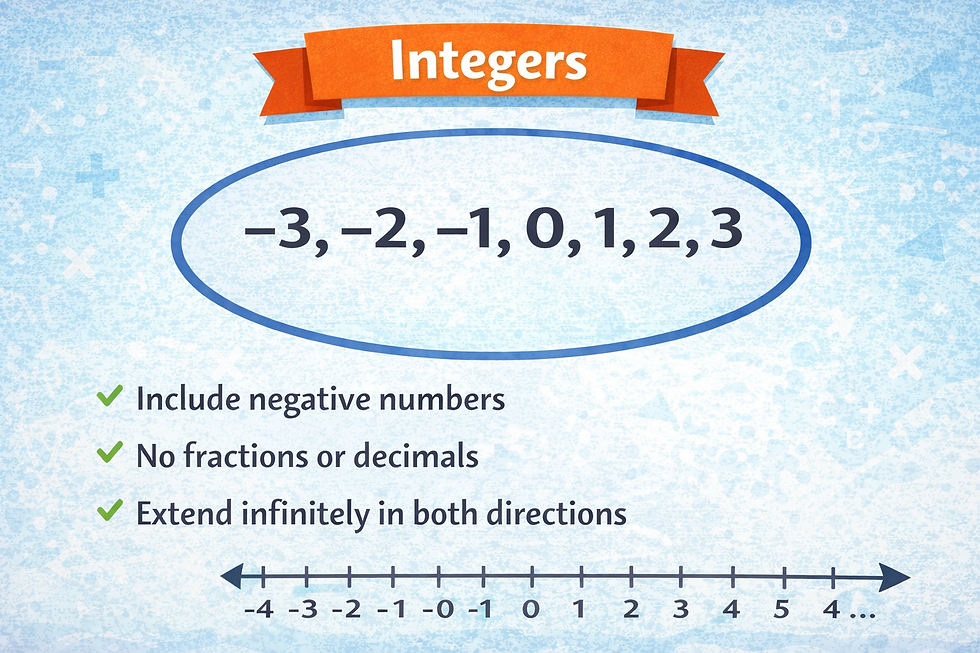
Integers include all positive and negative whole numbers, along with zero.
Examples:-3, -2, -1, 0, 1, 2, 3
Key Features:
Include negative numbers
No fractions or decimals
Extend infinitely in both directions
Integers are commonly used in real-life situations such as:
Temperature (e.g., -5°C)
Bank balance (profit or loss)
4. Rational Numbers

A rational number is any number that can be written in the form:
p/q, where q ≠ 0
Examples:
1/2
-3/4
5 (because 5 = 5/1)
0.75
Key Features:
Can be written as a fraction
Decimal form is either terminating or repeating
Includes integers
Example:
0.333... = 1/3 (repeating decimal)
Rational numbers are widely used in:
Measurements
Fractions in daily calculations
Money and finance
5. Irrational Numbers

Irrational numbers cannot be written as a fraction.
Examples:
√2
π (pi)
√3
Key Features:
Decimal form is non-terminating and non-repeating
Cannot be expressed as p/q
Example:
π = 3.141592653... (continues without repeating)
Irrational numbers are used in:
Geometry
Engineering
Scientific calculations
Difference Between Rational and Irrational Numbers
Rational Numbers | Irrational Numbers |
Can be written as p/q | Cannot be written as p/q |
Decimal terminates or repeats | Decimal never ends and never repeats |
Examples: 1/2, 0.5, 2 | Examples: √2, π |
Understanding the Number System Hierarchy
The real number system can be visualized as a hierarchy:
Natural numbers ⊂ Whole numbers ⊂ Integers ⊂ Rational numbers ⊂ Real numbers
Irrational numbers are also part of real numbers but separate from rational numbers
This means:
Every integer is a rational number
But not every rational number is an integer

Real-Life Importance of Number Classification
Understanding the classification of numbers helps in many real-life situations:
1. Finance
Rational numbers are used in:
Calculating interest
Handling money and transactions
2. Measurement
Fractions and decimals are essential in:
Cooking
Construction
Engineering
3. Science
Irrational numbers are used in:
Calculating areas and volumes
Scientific formulas
Why This Topic Is Important
Learning about the real number system helps students:
Understand number relationships
Solve algebraic problems
Build a strong mathematical foundation
It is also a key concept for higher-level topics such as:
Algebra
Geometry
Calculus
Conclusion
The real number system is a fundamental part of mathematics that includes different types of numbers such as integers, rational numbers, and irrational numbers. Each type has its own properties and applications.
By understanding how numbers are classified, students can develop a deeper understanding of mathematics and apply it effectively in real-life situations.
In the end, numbers are not just symbols—they are tools that help us measure, calculate, and understand the world around us.


Comments